Nostr Explained for Publishers: Keys, Relays and Why There Is No Server to Join
Nostr is the odd one out among the open social protocols. Mastodon has servers you join. Bluesky has data servers that hold your account. Nostr has neither. You are a pair of cryptographic keys, and your posts are signed messages you hand to whichever relays you like.
The name stands for "Notes and Other Stuff Transmitted by Relays." The design is deliberately small. That makes it hard to shut down and easy to build on, and it also makes it unforgiving.
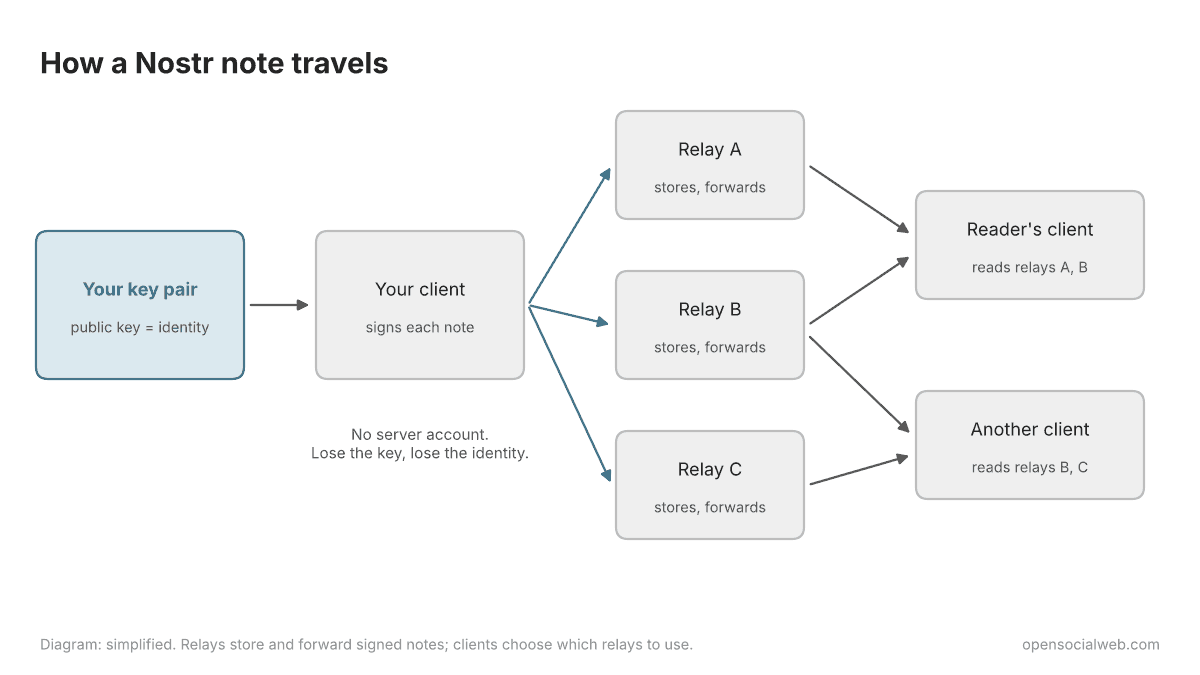
Diagram: Open Social Web, hosted at Pxef.com
Keys are the account
When you start on Nostr, a client app makes a key pair. The public key, usually shown as a string starting with npub, is your identity. Anyone can see it. The private key, starting with nsec, signs everything you post. Whoever holds it is you.
There's no password reset. Lose the private key and the identity is gone. Leak it and someone else can post as you, forever. For a publisher that's the first thing to get right: store the key in a password manager or a signer app, and don't paste it into random websites.
Relays are just mailboxes
A relay is a simple server that accepts signed notes, stores them and hands them to clients that ask. It doesn't own your account. It can't edit your notes, because the signature would break. It can refuse them, delete them or go offline.
So you publish to several relays at once, and your readers' apps read from several. If one relay drops you, the others still carry your notes. Some relays are free and open, some charge a small fee, some only accept certain people. That's how Nostr deals with spam and moderation: each relay and each client decides what it shows, and nobody decides for the whole network.
Things a publisher can actually use
A verified name on your domain. Nostr's NIP-05 standard lets you link a key to an address like [email protected]. You put a small JSON file at /.well-known/nostr.json on your site, listing the name and your public key. Clients then show the readable name with a check. It's the Nostr version of a domain handle, and it proves the key belongs to the site.
Long-form posts. A separate kind of Nostr event carries articles in Markdown, with a title and summary. Several clients display them as proper articles. You can publish your posts there in full, or mirror them from your site.
Tips in bitcoin. "Zaps" are small Lightning payments readers send to posts. Nostr grew up close to Bitcoin, and its users are more used to sending small payments than people on other networks. Whether that's worth anything depends on your readers.
The protocol grows through NIPs, Nostr Implementation Possibilities, short documents that describe a feature. Clients pick the ones they support, so features vary from app to app.
Where it falls short for publishers
The audience is small and leans heavily towards Bitcoin and privacy enthusiasts. Tooling for websites is thin next to the fediverse: there's no Nostr equivalent of the WordPress ActivityPub plugin that everyone uses. Key management is a real burden for a team, since everyone who posts for the brand needs the key or a signer service.
It also doesn't connect natively to Mastodon or Bluesky. Bridges exist, and Bridgy Fed has said it's considering Nostr, but as of November 2026 it bridges the web, the fediverse and Bluesky.
Should you bother
If your readers include Bitcoin or privacy communities, a Nostr presence with a NIP-05 name on your domain is cheap and well received. For everyone else, it's a low priority after RSS, the fediverse and Bluesky. Claim your name, publish a few posts, and watch whether anyone shows up.
For how Nostr stacks up against the other two, see ActivityPub vs AT Protocol vs Nostr. For the bigger picture, start at What the Open Social Web Is.