What the Open Social Web Is, and Why It Matters to Anyone Who Runs a Website
The open social web is the part of online social life that no single company owns. Your posts live somewhere you control, or at least somewhere you can leave, and people on other services can still follow you. The plumbing is a handful of open protocols. The best known are ActivityPub, Bluesky's AT Protocol, Nostr and plain old RSS.
That sounds abstract until you run a website. Then it becomes a practical question: when a platform changes its feed, closes its API or blocks links in a whole country, who still hears from you?
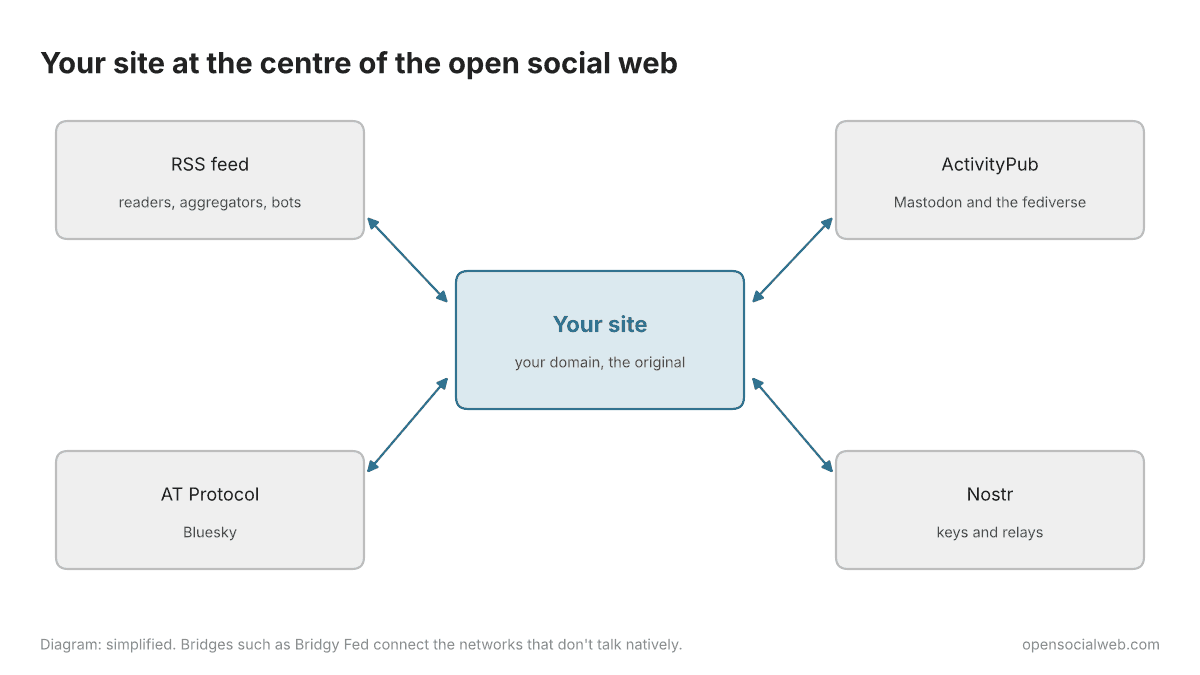
Diagram: Open Social Web, hosted at Pxef.com
The closed deal most sites signed
For about fifteen years the deal looked simple. You published on your site, then shared the link on Facebook, Twitter, LinkedIn or Reddit. The platform brought readers. You brought content. Nobody wrote the deal down, and the platforms kept the right to change it.
They used it. Facebook cut news out of the feed in stages from 2018 on. Twitter ended free API access in 2023, and Reddit priced its API so high the same year that most third-party apps shut down. Meta blocked news links in Canada from August 2023 rather than pay under a new law. Each time, sites that leaned on one channel lost readers overnight, and there was no one to appeal to. We go through those cases in Platform Risk: Four Times Publishers Were Cut Off.
Open protocols change the deal in one specific way. Your audience relationship stops being a row in someone else's database.
The four building blocks
ActivityPub is a W3C standard from 2018. Servers running it send each other posts, follows, replies and likes. Mastodon is the famous one, but Pixelfed, PeerTube, Lemmy, Threads and WordPress sites with the ActivityPub plugin all speak it. Together they're called the fediverse. A WordPress blog can be followed from Mastodon like any account. More in ActivityPub Explained for Website Owners.
AT Protocol runs Bluesky. It splits the job differently: your data sits in a personal data server, big relays collect everything, and apps build timelines on top. Your identity is tied to a domain or a portable ID, so you can move hosts and keep your followers. See Bluesky and the AT Protocol.
Nostr is the minimalist. You're a cryptographic key pair. You sign notes and send them to relays, which are simple servers that store and pass them on. No accounts, no instance to join. It's small but stubborn, and popular in Bitcoin circles.
RSS is the old one, from the late 1990s. It doesn't do replies or likes. It does one thing: anyone can subscribe to your site without asking a platform's permission. It still works, and it quietly feeds a lot of the newer tools. See RSS for Publishers.
Some people use "fediverse" for all of these. Strictly, it means the ActivityPub network. Bluesky and Nostr don't connect to it natively. Bridges such as Bridgy Fed join them up.
What it gets you as a publisher
Three things, in order of how much they matter.
First, portability. On ActivityPub and AT Protocol you can move your account and take your followers with you. On a WordPress site with ActivityPub, your followers are attached to your own domain from the start.
Second, no single feed algorithm between you and your readers. Mastodon timelines are chronological by default. Bluesky lets anyone build a custom feed. Nobody can quietly decide your links are worth less this quarter.
Third, your site becomes the hub. The pattern has a name, POSSE: publish on your own site, syndicate elsewhere. The open protocols make it cheap to do. We explain it in POSSE Explained.
What it doesn't get you
Scale, for now. These networks are small next to Facebook, Instagram or TikTok, and the audience skews technical. A fediverse following won't replace search traffic for a recipe site.
It also doesn't solve the newest threat. AI search answers and AI crawlers take content without sending visitors, and none of the social protocols fix that. That's why this site covers AI crawlers alongside the protocols. Start with AI Crawlers and robots.txt.
The honest pitch is insurance. Setting up a federated presence takes an afternoon. It won't double your traffic. It means that the next time a platform changes the rules, part of your audience is still reachable on terms you set.