POSSE Explained: Publish on Your Own Site, Syndicate Elsewhere
POSSE stands for Publish (on your) Own Site, Syndicate Elsewhere. The IndieWeb community gave it the name more than a decade ago, but the idea is older than social media: the original lives on your domain, and every other place gets a copy or a link pointing home.
It sounds obvious for a publisher. In practice, a lot of writing now starts and ends inside platforms. A thread on X, a LinkedIn article, a long Facebook post. When the platform changes or the account goes, the work goes with it. POSSE is the habit that stops that.
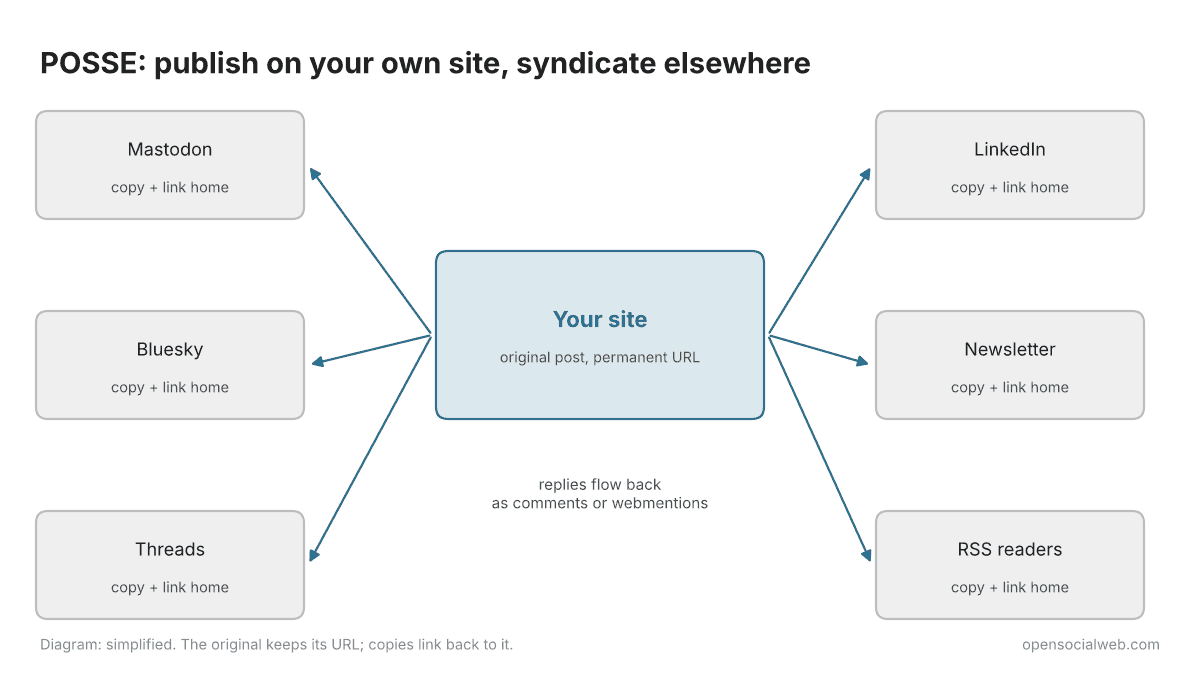
Diagram: Open Social Web, hosted at Pxef.com
The basic loop
- Write and publish on your site. The post gets its permanent URL there.
- Send a copy or a short version to the places your readers are: Mastodon, Bluesky, Threads, LinkedIn, a newsletter.
- Each copy links back to the original.
- Where you can, bring the responses home. Replies, likes and reposts from elsewhere show up on your post.
Steps 1 to 3 take minutes. Step 4 is the part that used to need special tooling and is now much easier thanks to the open protocols.
Why it works better now
On closed platforms, POSSE was mostly about pasting links. The open social web makes the syndication automatic and two-way.
- WordPress with the ActivityPub plugin makes the site itself a fediverse account. Publishing is syndicating, and replies arrive as comments. See the WordPress ActivityPub guide.
- Bridgy Fed turns a site's feed into accounts on the fediverse and Bluesky, and sends interactions back as webmentions. See Bridgy Fed for Websites.
- RSS lets newsletter tools, aggregators and bots pick up new posts without you lifting a finger. See RSS for Publishers.
- Webmentions are the IndieWeb's standard for one site telling another "I replied to you." A site that accepts them can show conversations from across the web under a post.
What to syndicate, and how much
There's no one rule, but a few patterns hold up.
Short posts in full, long posts as a hook. A note of a few hundred characters can go out whole. An article gets a title, a line or two and the link. On Bluesky the 300-character limit decides for you.
Write the hook for the network. The same link with the same blurb on every service reads like a bot. A sentence written for Mastodon's crowd and a different one for LinkedIn's costs two minutes and gets more clicks.
Keep the canonical tag. If you republish full articles on Medium or another site that allows it, set the canonical URL to your own post so search engines credit the original.
Don't syndicate everything. Some posts only make sense on your site. Some only make sense as a quick social post. POSSE settles where the original lives. It doesn't oblige you to post everywhere.
The related idea: PESOS
The IndieWeb also names the reverse: Publish Elsewhere, Syndicate (to your) Own Site. You post on a platform first, for its reach or its tools, then copy it to your site. It's the fallback when the platform does something your site can't, like Instagram stories. Bluesky and Mastodon profile feeds make PESOS easy: pull your own posts in through RSS and archive them on your domain.
What it protects
POSSE won't grow an audience on its own. Its job is to make sure the work and the links survive whatever happens to any one channel. Your archive, your URLs, your search history and your subscriber relationships stay on a domain you control.
That's also the best position to be in when the next channel shows up. You just add it to step 2. For the background on why this matters now, read Platform Risk: Four Times Publishers Were Cut Off.