Newsletter vs RSS vs Fediverse, Which Audience List Does a Publisher Actually Own
"Own your audience" is advice every publisher has heard. It usually means "start a newsletter." That's good advice, but ownership comes in degrees, and the three channels that get recommended most, email, RSS and the fediverse, give you different kinds of it. A platform account gives you the least.
Four questions sort them out. Can you see who your readers are? Can you take the list with you? Is anything ranking or filtering between you and them? And can one company switch it off?
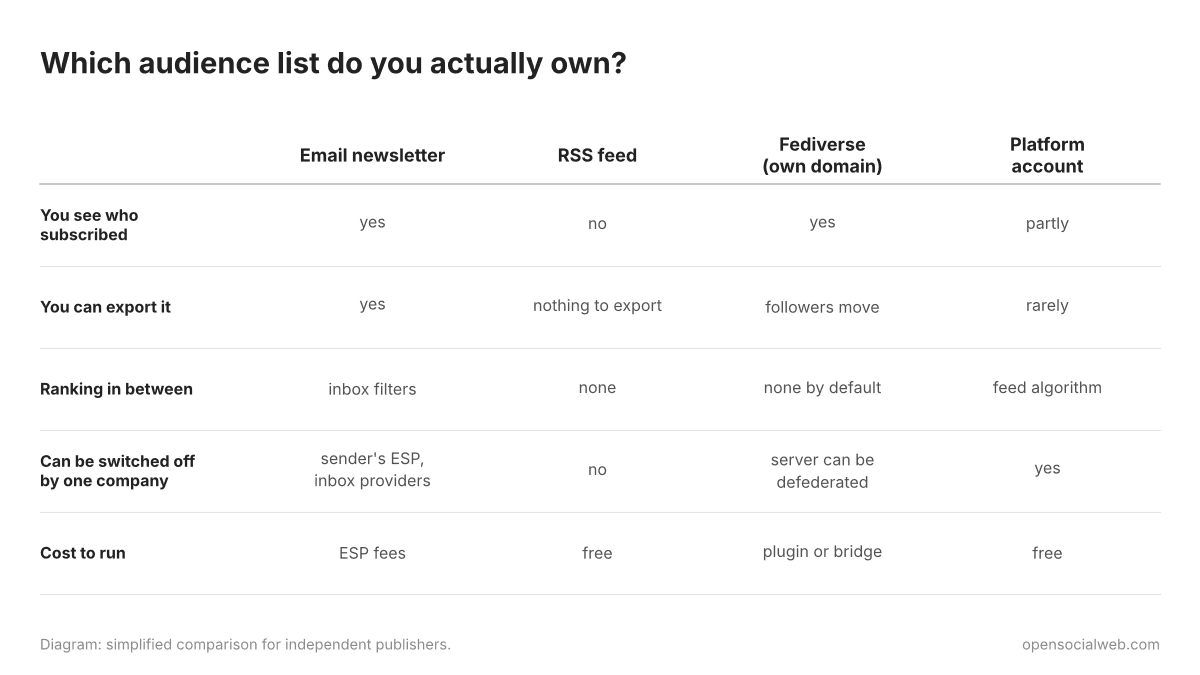
Diagram: Open Social Web, hosted at Pxef.com
Email newsletter
What you own: the list. Names and addresses, exportable as a file from any decent email service. That's the most portable audience asset there is.
What you don't: the inbox. Gmail and Outlook filter, sort and tab mail, and a newsletter can slide into Promotions or spam without you knowing. Your email service can also suspend an account. You can move to another provider, but deliverability takes work: authentication records, a clean list, a sending reputation that builds over time.
Cost: email services charge by list size, and it adds up.
RSS
What you own: the channel. Nobody sits between your feed and a reader's feed app. No ranking, no filter, no account to suspend.
What you don't: the list. RSS is anonymous by design. You can estimate subscriber counts from feed-fetcher stats, but you can't email those people or export them. They follow the feed URL, so keep that URL stable forever.
Cost: nothing. Your CMS makes the feed. Getting it right takes a little care, covered in RSS for Publishers.
Fediverse, on your own domain
What you own: a follower list attached to a handle on your domain, through the WordPress ActivityPub plugin, Ghost or a bridge. You can see who follows you, and the relationship lives at your address. Timelines are chronological by default.
What you don't: the reach of each server. A server's admins can block yours, and their users stop seeing you. It's local, not global, but it happens.
Cost: a plugin or a bridge. The setup is an afternoon. Details in Custom Domain Handles on Bluesky and the Fediverse.
A platform account
For contrast: on Facebook, Instagram, X or LinkedIn you see your followers, but you can't take them anywhere, a ranking algorithm decides who sees each post, and the company can change the rules or close the account. Most publishers keep these accounts for reach. They just shouldn't count them as owned.
How to combine them
They aren't rivals. Each covers a gap in the others.
- Email for the readers who want you in their inbox and for anything you'd need to reach everyone with, like a move or a paid product.
- RSS as the free, permanent base layer that feeds readers, aggregators and bridges.
- The fediverse for conversation: replies, boosts and discovery through people, tied to your domain.
- Platforms for reach, run on the POSSE pattern so your site stays the original.
With search referrals falling for small sites, as covered in AI Answers and Google Search Referrals, these owned channels are where the work pays off longest.