AI Answers and Google Search Referrals, What Small Publishers Are Losing and What Still Works
For most independent sites, Google was the one platform that kept its side of the deal. You published something useful, it ranked, people clicked. AI answers are breaking that. Google's AI Overviews and AI Mode, plus chatbots like ChatGPT, answer the question on the results page, and fewer people click through to the site that supplied the answer.
The size of the hit depends a lot on who you are. The numbers published through 2026 point the same way, and they're worst for the smallest sites.
What the data shows
Chartbeat figures reported in March 2026 put the drop in Google search referrals over the past year at 60% for small publishers, 47% for medium publishers (10,000 to 100,000 daily pageviews) and 22% for large ones. Google search traffic across the publishers it tracks fell by about a third. Chatbots made up for almost none of it: they still sent under 1% of publisher referrals, even after ChatGPT referrals grew more than 200% during 2025.
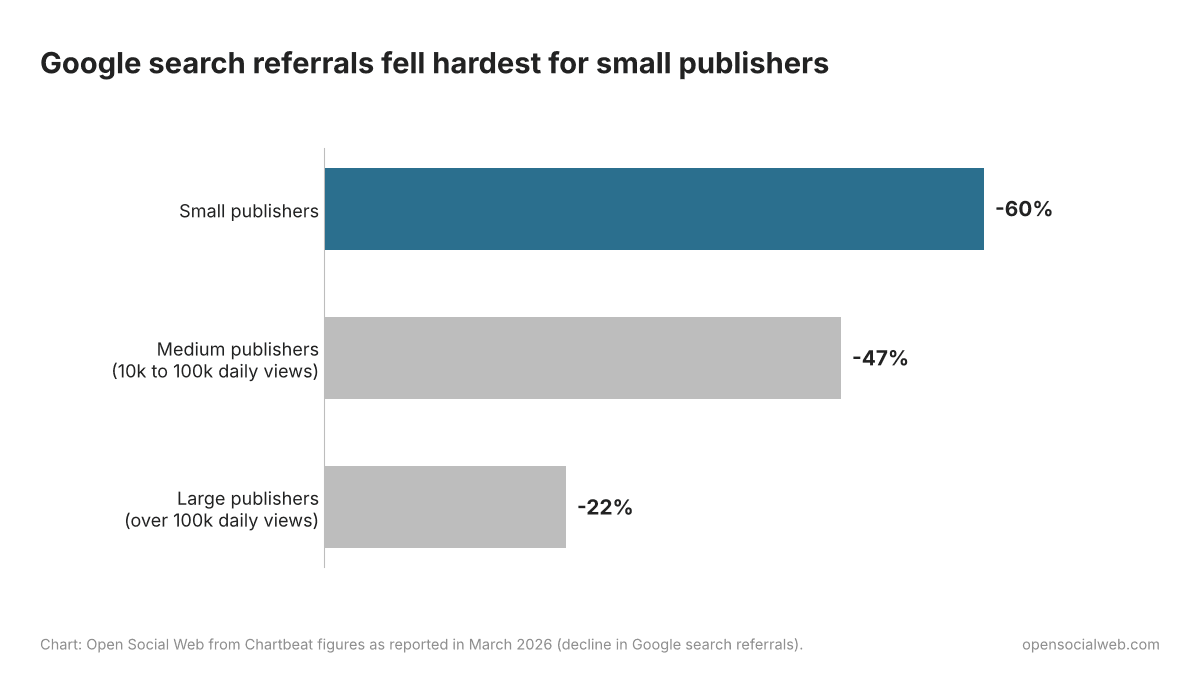
Chart: Open Social Web from Chartbeat figures, hosted at Pxef.com
Other studies line up. In the UK, an Association of Online Publishers study of eight publishing groups found news publishers losing around 5% of Google referrals a quarter and consumer and B2B publishers around 18%. A preregistered field experiment with 1,100 Google users, published as a preprint in August 2026, found that people pushed into AI Mode clicked through to outside sites 18.8 percentage points less often, and to news sites 12.5 points less, without reporting a better search experience.
Google disputes the scale of these estimates. Publishers' own analytics are the better guide for any one site, and it's worth checking yours by section and query type.
Why small sites get hit hardest
Large publishers have brands people search for by name, apps, newsletters and direct visitors. Their Google traffic was one channel among several. Small sites tend to live on informational searches, the "how do I" and "what is" questions that AI answers handle best. When the answer appears on the results page, there's no reason to click.
What still brings readers
The same Chartbeat report noted that overall traffic fell much less than search traffic, about 6% between 2024 and 2025, because email, apps and messaging grew. Large publishers have been moving their effort into newsletters and direct traffic. Small sites can copy that move on a smaller budget:
- Build direct channels. An email list, an RSS feed that's actually good, a fediverse account on your own domain. All three reach readers without a search engine in between. Which one you truly own is compared in Newsletter vs RSS vs Fediverse.
- Write what an AI summary can't replace. Original testing, first-hand reporting, data you collected, opinion with a name behind it. A summary of the web can't summarise what isn't on the web yet.
- Decide your AI crawler policy on purpose. Blocking training crawlers while allowing AI search crawlers is the common middle path. The choices and trade-offs are in AI Crawlers and robots.txt, and the enforcement side in Cloudflare's AI Crawler Controls.
- Measure per page type. Evergreen how-to pages usually lose the most. News and opinion lose less. Knowing which is which tells you where to put the next month's work.
The honest outlook
Nothing here brings search back to where it was. The likely direction is more AI answers, not fewer. The publishers coming through best are the ones who stopped treating Google as the audience and started treating it as one road to an audience they hold themselves. That's the same lesson as every platform cut-off before it, arriving from the biggest platform of all.