RSS for Publishers in 2026: Why the Oldest Open Feed Still Matters and How to Get Yours Right
RSS has been declared dead at least once a decade. Google shut down Google Reader in 2013 and a lot of people took that as the end. It wasn't. Podcasting still runs on RSS feeds. News apps, aggregators, email newsletter tools, Slack and Discord bots and many fediverse bridges read RSS under the hood. Bluesky added an RSS feed to every public profile in 2024. Mastodon has had them all along.
For a publisher, RSS is the one subscription channel nobody can switch off. There's no algorithm, no account to ban, no API price. A reader asks for your feed, gets your posts, done.
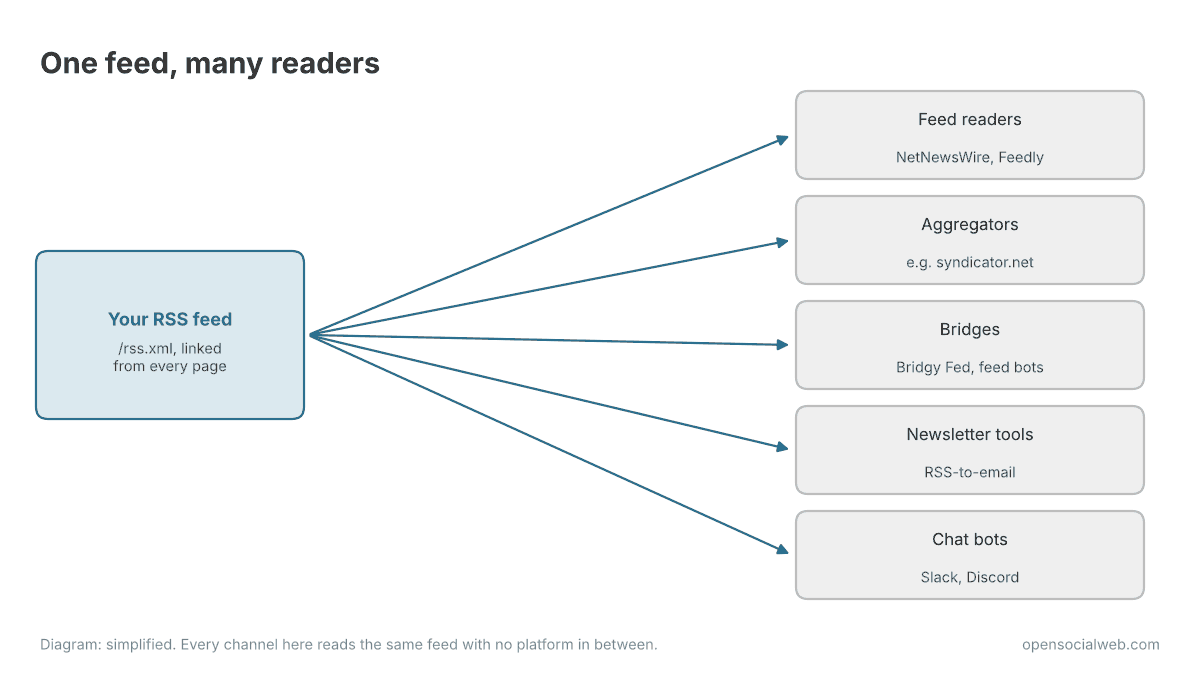
Diagram: Open Social Web, hosted at Pxef.com
Why it matters more now
The platforms that used to carry links are carrying fewer of them. Search is answering more questions without a click. In that setting, a reader who subscribed to your feed is worth more than one who might see you in a timeline someday.
RSS also feeds the open social web. Bridgy Fed can turn a site's feed into a fediverse and Bluesky account. Feed-to-Mastodon bots post new articles automatically. Aggregators like Syndicator gather many sites' feeds into one stream. If your feed is broken or thin, all of that breaks or goes thin with it.
Getting your feed right
Most CMSs and static site generators make a feed by default. Default isn't the same as good. Check these:
Make it discoverable. Your page head should carry a link that tells browsers and readers where the feed is:
<link rel="alternate" type="application/rss+xml" title="Site name" href="https://example.com/rss.xml">
With that in place, a reader can paste your home page address and find the feed itself.
Full text or summary. Full text is kinder to readers and better for bridges, which need something to post. Summaries bring more clicks back to the site. A good middle ground is a solid opening paragraph or two plus the link. Whatever you pick, make sure the summary isn't just the first 20 words of a cookie banner.
Include the lead image. Many readers and bridges show an image if the feed carries one. Put the featured image in the item, with an absolute https URL.
Use stable IDs. Each item needs a permanent unique ID, usually the post URL. If IDs change when you edit a post or switch themes, every subscriber's reader shows your whole archive again as new.
Carry enough items. Ten is a common default. Twenty to fifty is friendlier to readers who check weekly and to services catching up after downtime.
Keep it valid. One bad character can break a feed for strict readers. Run it through the W3C feed validator after theme changes.
Don't block feed fetchers. Firewalls and bot rules sometimes block feed readers because they don't look like browsers. Check your feed URL from outside your network, and check your security settings for anything that challenges requests to it.
Feeds you can pull, not just publish
RSS works in the other direction too. Every Bluesky profile has a feed at its profile address plus /rss. Mastodon profiles have one at the profile URL plus .rss. YouTube channels have feeds. A site can use these to pull its own social posts back onto its pages, or to keep a watch list of sources without opening five apps.
Telling readers it exists
The biggest problem with RSS isn't technical. People don't know a site has a feed. Put a visible feed link in the menu or footer. Mention it on the About page. Some sites add a short "follow by RSS" line under each post, next to the fediverse handle.
RSS will never be the biggest channel you have. It's the one most likely to still work in ten years, and the cheapest to keep. That makes it the base layer of POSSE, and a good first step if you're just starting on the open social web.